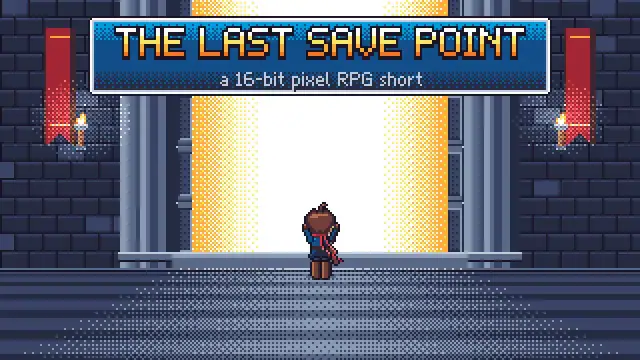
HD-2D HD-2D
The Lampbearer·1:17·Lemo-Opuscarby Lemomo
Hand-made pixel sprites standing like paper cut-outs inside a lit, fogged, fully 3D diorama, shot from a high three-quarter angle through a tilt-shift lens: a toy world where every lamp throws a real shadow.
The demo: The lighthouse goes dark; a girl carries the last flame through a night forest and up the storm cliffs.
Hand-made pixel sprites standing like paper cut-outs inside a lit, fogged, fully 3D diorama, shot from a high three-quarter angle through a tilt-shift lens: a toy world where every lamp throws a real shadow. References (grammar only): Octopath Traveler (Square Enix × Acquire, 2018) and its sequel (2023), the games that defined the HD-2D look. Learn the grammar: sprite-in-diorama, high 3/4 camera, tilt-shift focus band, point lights with shadows, heavy bloom and vignette, framed dialogue box. Never use their characters, places, logos, UI ornaments or music, and never name them in the film.
1. Essence, and what it is not
A 3D miniature set of boxes and cylinders wrapped in pixel-art textures, populated by flat 2D pixel sprites that receive light and cast shadows, seen from a high, far camera through a tilt-shift band so the world reads as a tabletop model. Light is the subject: practicals throw sprite shadows across the floor; shafts, fog, dust or rain hang in the air; strong bloom, heavy vignette. On top, a small RPG UI: chapter card, framed dialogue box with typewriter text, serif subtitles.
The key contrast: characters stay flat, low-res and stepped while camera, light, particles and focus move smoothly every frame.
Not a voxel game (no cubic characters), not a flat 2D pixel RPG (the set is real 3D with real light), not a tilt-shift photo of a real miniature (textures are pixels, not materials).
2. Materials & rendering
- Constant texel density: surfaces drawn per pixel on small canvases,
NearestFilter, world-space UVs at one density (e.g. 24 px/m); sprites on a similar scale (a character ~30–60 px tall). - Colour from ramps: 3–6 swatches picked by brightness through a narrow 4×4 Bayer dither. Sprites get a 1 px selout outline (neighbour colour darkened toward the ink).
- Boxes and cylinders for buildings, floors, rock; billboards (instanced) for foliage, distant props, ridges. Windows are emissive pixel panes; fire is a pixel atlas stepping at ~10 fps; water a shader with quantized ripples and light columns toward the camera.
- Light rig per set: one dim shadow-casting key, a hemisphere fill, practical point lights with shadows (lamps, fires, windows, screens), and a front fill ~2 m before the hero (a billboard lit from behind stays black). An additive glow sprite on every source gives bloom something to grab.
- Post chain, at render time: supersampled render → physical DOF with tilt-shift in the same signed circle of confusion (above the band = far, below = near; far never bleeds over a sharp foreground) → bloom → vignette/grade → filmic tone map. No film grain.
3. Colour logic
- Two temperatures: one large ambient key (cold, or pale, or dusty) against small warm or saturated practicals. The practicals carry the story; the ambient carries the mood.
- The darkest value is a warm ink, never pure black; the brightest is the light source itself, bloomed.
- Each set owns one fog colour and one light key, so a cut to a new place reads instantly.
- The hero wears the one saturated costume colour that no set uses, so the tiny sprite is findable in a wide.
- UI is one metal (gold, silver, copper) plus one paper white over a dark translucent plate.
- Examples: night harbour (blue fog, amber windows); autumn market at dusk (violet sky, pink paper lanterns); snowy mine at noon (grey-white daylight, green mineral glow).
4. Type & subtitles
- An inscriptional capital serif (Cinzel, wide tracking) for chapter labels and titles; an old-style serif (Cormorant, Cormorant Garamond italic) for subtitles, dialogue, taglines. All OFL.
- Narration subtitles: italic serif ~46–54 px, centred low on a soft dark gradient band, one line per voice clip, in ~0.35 s before the voice.
- On-screen speech gets a dialogue box, not a subtitle: dark plate, thin metal border, corner ornaments, name plate on its top edge, text typed over ~90 % of the voice, blinking caret, soft chime on entry.
- Chapter cards and a title card belong to the grammar. Hold ≥ max(1.8 s, speech + 0.6 s). Export the
.srtfrom the data that drives the overlay.
5. Motion quality
- Sprites step, everything else glides. Walk cycles 4 frames at 6–10 fps, idles alternate two frames at ~1–2 Hz, blinks every few seconds, pose changes are instant cuts between drawings. Camera, lights, particles, beams and focus update every output frame (60 fps).
- Poses are data: a parameter object per drawing; a new pose is a new table entry.
- Lights breathe: every flame flickers (a few summed sines, about ±20 %). A light's level is one value that drives the sprite drawing, the point light (intensity ∝ level^~1.3), the glow opacity and its scale together.
- Weather is procedural: slanted rain streaks; lightning as a scripted flash curve (strike, dip, re-strike, decay) lifting sky, fill and exposure together.
- The world never shakes except for impact; the set never moves, only the camera and what lives in it.
6. Camera grammar
A vocabulary, not a route. Opening and ending come from the topic. Always look down on the world (never at eye level); every path is a monotone spline of a few keys, no overshoot; focus is recomputed every frame from camera to the subject.
| Move | Expresses | Can serve |
|---|---|---|
| Very high, very far, slow push; band on one tiny subject | Preciousness, a whole place as a map | where we are; scale; a landmark |
| Medium-high 3/4, near-static drift | Two figures on one stage | a conversation; a handover; a choice |
| Lateral tracking, camera leading slightly, foreground passing blurred | A path through a world | travel; a process with steps; a commute |
| Dive low and close while a figure kneels or stops | The toy world suddenly personal | exhaustion; care; a secret |
| Rising pull-back, focus handed from figure to object | The act spreads outward | consequence; a system switching on |
| Orbit half-way round a building or prop | An object seen from all sides | a workshop; a machine; a monument |
| Top-down, straight overhead, tilt band as a strip | A board game, a plan | routes; a schedule; a queue |
| Rack focus between two depths in a locked frame | Attention changing hands | a memory; someone watching; before/after |
| Return to an earlier framing, changed | The rhyme shows what changed | aftermath; growth; a season later |
Framing: characters ~1/12–1/8 of frame height; the sharp band follows the subject's projected height (clamped ~.2–.8 of screen); with no character, use a fixed band height per shot. Transitions: short fades to black or cuts between sets; no wipes, no 3D spins.
7. Sound palette
- Music: chamber-fantasy or cinematic colours (harp, celesta, strings, horns, low choir, timpani) or small folk instruments (lute, recorder, hand drum). Either one piece whose own arc matches the story, cut inside it at downbeats, or an original score; a downbeat can land on the frame of a visual event.
- Silence as a tool: a hard stop into a reverb tail, a pad alone, or one heartbeat when the light nearly dies; a short breath (< 1 s) when something fails.
- Foley follows the diorama's matter: footsteps per surface (wood, dirt, stone, snow), fire crackle, cloth, a UI chime for dialogue boxes and menus, small bells for things switching on, thunder after each flash, a deep boom with shimmer for a big ignition; ambience beds per set, crossfaded.
- Voice: storybook narrator, slow (speed ~.82–.90); on-screen characters low-passed (~7 kHz) so they sit "in the world". Put invented names in the TTS
asrfield. - Mix: lines compressed and RMS-matched; per-line auto-duck ~10 dB (down only); −14 LUFS via
core/render/mux.sh, grain 0.
8. Native moves
A menu: use the ones your story needs.
- Shadows jump when a light is lit. A practical turns on next to sprites and their shadows swing across the floor. Fits content like: a shop opening at dawn; a server rack powering up; a teacher switching on a projector.
- The carried light as a meter. One small light the hero holds is key light and emotion at once: bright → guttering → almost out → relit. Fits content like: a phone battery on a long trip; a patient's heart monitor; a candle vigil.
- Tilt-shift preciousness. An extra-wide with the band on one tiny subject. Fits content like: a single delivery van in a city; a newborn's room in a whole hospital; one stall in a night market.
- Lights popping on one by one. Windows, lamps or boats light up at a steady cadence across the map. Fits content like: users joining a network; a village getting electricity; a festival beginning.
- RPG grammar. Chapter card, named character in a dialogue box, biomes, a landmark, a title card. Fits content like: onboarding a new employee; a history in eras; a recipe in stages.
- Weather passes over the diorama. Rain, snow or lightning sweeps the tabletop with the flash curve. Fits content like: a market crash; a harvest threatened; a hard week at work.
9. Pitfalls of the medium
- Checkerboard everywhere → the dither band is too wide (≈ .22 on sprites, ≈ .45 on textures).
- A light burns out the sprite that holds it → move the light ~0.45 m toward the camera; cap sprite lighting in the shader (
min(outgoingLight, diffuse * 1.35 + emissive)). - Lights behind a billboard don't light it (front normal only) → always the front fill.
- Cylinder beams facing the camera give NaN that bloom spreads into black blocks → billboard beam cards that fade toward the lens, glow sprite takes over.
- Dark scenes unreadable → lift environment mid-tones ~×2–2.5 outside the one beat that must go dark.
- Distant glows hidden by fog →
depthTest = false, higherrenderOrder. - Tilt-shift with no character to track → fixed band height per shot. Tilt as a separate blur pass breaks occlusion → fold it into the DOF's signed CoC.
- Node render scripts may not exit after
done(server keep-alive) →process.exit(0); the file is complete oncedoneprints.
10. Engine
In demo/: px.js (pixel canvas, Bayer ramps, surfaces, lit billboards, glow), kit.js (world UVs, materials, houses, props, pixel fire), fx.js (sky, pixel sea, particles, rain, beam cards, flick), chars.js (pose-table pixel characters, makeChar), post_ts.js (makePost: DOF + tilt-shift + bloom + grade), ui.js (chapter card, dialogue box, subtitles, title), main.js (page contract, ?tilt=1). Module table, parameters and a minimal new set (a lantern-lit alley): DEMO.md § Engine reference.
11. Variation space
You decide the places, the characters, the light the story turns on, the chapters, the opening, the ending, the camera path, the key temperature and the music. All far from our demo:
- Structures: a day-cycle map (one set, dawn to night, each hour lit by different practicals as the town's routine unfolds); a party of three (three short chapters, each character's biome and light, converging in one room); a menu of places (a top-down overworld; the camera dives into one location per topic point and pulls back to the map between).
- Openings: in the middle of the room (a dialogue box already typing over a close 3/4 shot); overhead map (straight top-down, the band as a strip, then tilt down into the 3/4 view); daylight (a bright noon wide with no practicals at all, so the first lamp later is an event).
- Endings: a save point (the hero rests at a small glowing object, the UI shows a save line, fade); the band narrows (the sharp strip thins onto one sprite until everything else is blur); the party leaves frame (a locked wide holds after the characters walk out; only ambience and flicker remain).
How our demo was made (story, shots, score, end card, build): DEMO.md. Read it after your treatment exists.
Director's notes for the demo film
One example among many. Don't reuse its story, arc, shots, props or timings.
Demo: The Lampbearer (76.5 s, 1920×1080, 60 fps) · hd-2d.mp4 (the tilt-shift cut) · source in demo/ (local only) · engine: three.js r170 scenes + procedural pixel textures + custom physical DOF / tilt-shift post (demo/post_ts.js) + Canvas2D overlay UI, rendered frame-by-frame with core/render/video.mjs.
Story & structure
A harbour town's lighthouse goes out; the old keeper hands the last flame to his granddaughter Wren, who carries her lantern through a night forest and up a storm-beaten cliff stair to relight the lighthouse, so the ships at sea can find their way home. Tagline: Every path begins with a single light.
How the demo spent the style's native powers:
| Native power | Story use |
|---|---|
| A light the hero carries | The lantern is both key light and plot: Wren carries one small light that must reach the lighthouse. Its brightness is the emotional meter: bright → guttering → almost out → relit. |
| Tabletop world | Places read as maps: a harbour town, a forest path, a cliff stair, a tower top. One location per chapter, each with its own light key. The opening set returns at the end to show the change (harbour: lighthouse dark → lit, ships' lamps appear). |
| RPG grammar | "Chapter I" card, a named NPC who hands over the quest in a dialogue box, a journey through two biomes, a climax at a landmark, a title card. |
| Sprite shadows | The first lighting (brazier taper → lantern) happens on screen, next to two characters, so both shadows jump onto the planks. |
| Tilt-shift | Extra-wide establishing shots with the focus band on a single tiny subject (the lighthouse, a boat). |
Our story shape: cold chapter card → wide establishing shot where the landmark light fails → quest handed over in a dialogue box (the light is passed) → travel through a darker biome (forest) → the ordeal (storm; the light almost dies; the music drops out) → the light survives → the landmark is relit (climax on a music downbeat) → the opening set, transformed → title and tagline.
We kept it to 6 shots, one set per 1–2 shots, 7 narrated lines + 1 dialogue line. The "one small light" was a lantern; in another film it could be a first commit, a seed, a letter, a signal — or no carried light at all.
Shots
| Shot | Camera |
|---|---|
| Establishing (harbour wide, 5.5–15) | Very high and far ([-17,15,38] → [-13,12,31], fov 36), slow push. Focus 44 m, aperture 520; tilt band fixed at 34 % screen height (no character to track). |
| Dialogue (pier, 15–25.5) | Medium-high 3/4 (≈5 m up, 8–10 m away, fov 30), almost static drift. Focus on the hero every frame, aperture 300. |
| Travel (forest, 25.5–35.5) | Lateral tracking, camera leads the walker slightly (monotone look-ahead), fov 30, 6.3 m up; near ferns in front of the lens blur into dark shapes; she walks behind a foreground trunk at the end. Aperture 380. |
| Ordeal (storm stairs, 35.5–49.5) | Starts as a huge establishing view of the cliff, eases into a follow cam (37–39 s), then dives low and close as she kneels (camera to ~2.2 m up, 6 m away), and pulls back as she climbs on. Aperture 140–170 (closer = less blur). |
| Climax (lamp room, 49.5–58) | Medium on the hero at the lens; after ignition, a rising pull-back to a wide of the tower (fov 30 → 40, aperture 150 → 320), focus switches from hero to lens. |
| Resolution (harbour end + title, 58–76.5) | Mirror of the opening but wider and higher ([-22,26,44] → [-27,33,55], fov 42), focus 70, aperture 380, tilt band at 36 %. |
Rules: always look down on the world (never eye level); every camera path is a track() of 2–7 keys (monotone cubic, no overshoot); focus distance is recomputed each frame from camera to the hero (post.dof.focus = cam.position.distanceTo(hero + (0,.7,0))); in the tilt cut the sharp band follows the hero's projected screen height (tiltCenter, clamped .2–.8).
Score structure
- Voices (Kokoro via
core/tts/tts.py): narratoraf_heart, speed .82–.90 (slow, storybook); the quest-giverbm_george, speed .84, low-passed at 7 kHz in the mix so he sits "in the world". 7 narrated lines + 1 dialogue line, each 1–5.4 s. Check withcore/tts/asr_check.py; put invented names in theasrfield (Graywater,Ren,whisper would), otherwise whisper flags them. - Music: one licensed track, edited to picture: Scott Buckley, Precipice (CC BY 4.0), cut by
music/edit.pyinto five sections (intro pad → 0.8 s breath when the lighthouse dies → continuous build through forest and storm → hard stop into a reverb tail at 42.0 when the flame nearly dies, only the intro pad under it → the composer's own build → its D→G♭ key-change downbeat placed at 53.500 s = ignition, located automatically by the steepest < 250 Hz onset (error < 5 ms) → jump to the final E♭ arrival for the title). All cut points are inmusic/CUES.md. Pick one piece whose own arc matches the story; cut inside it rather than stitching tracks. - Ambience & foley (
mix.py, synthesized withcore/audio/sfx.py): per-set beds with crossfaded gain curves (harbour waves + rope creaks, brazier crackle, forest crickets + leaves, storm rain + wind with a gust swell), and events: lamp-out "fwoomp" 12.3, match strike 16.15, UI chime on the dialogue box 17.3, footsteps fromsfx_events.json(wood / dirt / stone), thunder 0.25 s after each flash, wind whoosh at the gust, two heartbeats in the silence, the ignition boom (42 Hz drop + air + high shimmer) at 53.5, six small bells as the ships light up. - Mix: each voice line compressed and RMS-matched; buses levelled to voice −17, music −21, ambience −30, foley −27 dB RMS; music ducks ~2.2 dB under voice, then a per-line auto-duck pulls music + ambience to ≈10 dB under each line (only down, never up; the script prints the achieved gap per line, 7–14 dB in the demo);
tanhsoft-clip; final loudness bycore/render/mux.sh(two-pass loudnorm −14 LUFS, TP −1.2).
Palette & props
The demo is a night film: cold blue against warm amber fire, strong bloom, heavy vignette.
Resolution & pixels. Scene textures are drawn per pixel on small canvases (PX class, px.js) and uploaded with NearestFilter; world-space UVs (worldUV, kit.js) keep 24 px/m on every surface. Characters are 34×50 px frames at SPX = 1/30 m per pixel (≈1.67 m tall). Colour comes from ramps (3–6 swatches) chosen by brightness with a 4×4 Bayer dither; the dither band dz must be narrow: .22 for characters, .45 for textures (wider = checkerboard noise everywhere). Sprites get an automatic 1 px selout outline (PX.outline(.3): transparent pixels next to the sprite become the neighbour colour darkened toward #16 0e 1e).
Palette (night). Sky #050818 → #101d3e → #2c4262 (horizon), fog #16223a (harbour) / #152a48 (forest) / #1c2334 (storm), moon light #8fa8e0, hemisphere #3a4c7a / #0a0a12. Fire and windows #ff9d4a, #ffae55, #ff8c3a, lantern #ffb050, lighthouse #fff0c8. Cool character fill #9fb2e8. Hero cloak ramp #2e0b14 … #c9503f (crimson), scarf gold #b08424; keeper coat navy #10131f … #5a6c98, beard greys. Ink #1a1016.
Materials. Boxes and cylinders only: houses with plaster + timber beams (plaster), shingle roofs (shingles), planks with nail dots (woodPlanks), Worley cobbles (cobbles), layered rock (rock), bark/canopy/fern/grass/mushroom sprites (forest_art.js). Foliage, grass, ferns, mushrooms, distant ships and ridges are billboards (instanced where many). Windows are emissive pixel panes (windowMat, emissive 2.2). Fire is a 6-frame pixel atlas billboard at 10 fps (fire). Sea is a custom shader: quantized pixel ripples, crest bands, light reflection columns stretched toward the camera, sparkle glints.
Light rig per set. One dim shadow-casting moon (DirectionalLight 1.1–1.2, 2048 map) + hemisphere fill + practical point lights (windows 8, street lamps 12–14, brazier 16 with shadows, lantern 2.6–14 with shadows) + a cool front fill (#9fb2e8/#8fa6e0, 1.2–1.8, range 6–8 m) placed ~2 m in front of the hero. Additive glow sprites sit on every light source so bloom has something to grab.
Post chain (post_ts.js, makePost(renderer, scene, camera, 1920, 1080, { ssaa: 2 })): render at 2× (3840×2160 internal) with MSAA → physical DOF (CoC = aper × (1/focus − 1/z) px, 96-tap spiral gather, far samples cannot bleed over a sharp foreground) + tilt-shift → UnrealBloom (strength .55, radius .75, threshold .85) → vignette/grade (amt .62, warm .1, contrast .2, sat 1.05) → ACES filmic, exposure 1.15. Tilt-shift cut adds: tiltAmt 17, band half-width tiltW .075, feather tiltF .3 (fractions of screen height), maxCoc ≥ 24, saturation ×1.16, contrast .28.
Type. Cinzel 500/700 (chapter label, title), Cormorant Garamond italic 500 (subtitles, tagline), Cormorant 500/600 (dialogue text, name plate). Gold #d8c28e / #e2c989 / #c9a863, parchment white #f3ead6 / #f6f0e2.
Motion as built:
- Sprites step, everything else glides. Walk cycles use 4 frames at 6–10 fps (
['w0','w1','w2','w3'][Math.floor(t*9)%4]), idles alternate two frames at ~1.4 Hz, blinks every few seconds, poses swap instantly (upE → up → idle). Camera, lights, particles, beams and focus update every frame at 60 fps. - Poses are data: a frame is a parameter object (
{ step, arm:'low'|'fwd'|'up'|'hug'|'pour', kneel, lit, bob, hem, scarf, blink, closed, look }) drawn bydrawWren/drawKeeper. Add a pose by adding a table entry (or passextratomakeChar). - The light breathes:
flick(t, seed)(three summed sines, ±20 %) on every flame; the lantern'slitvalue (0–1) redraws the flame size in the sprite and drives the point light (intensity ∝ lit^1.3), glow opacity and scale. - Events are timestamps in
story.jsT(lighthouse flicker 11.5 → out 12.35, taper 16.2, gust 40.6, dim 41.3, dark 42.0, relight 45.6, stand 47.6, pour 52.6, ignite 53.5, beams 54.4, ships 59.2). Scenes blend withss(seg(t,a,b)). - Signature beats: lighthouse flickers twice and dies; brazier taper lights the lantern and both sprites' shadows jump onto the planks; the gust shrinks the flame to an ember (sprite
lit .27), world goes almost black, then the flame re-grows; the lens ignites with an exposure burst (exp(-(t-53.5)/.22)) and two beam cards start sweeping; ships' lamps pop on one every 0.7 s and drift toward the harbour. - Weather is procedural: rain = wind-slanted line segments (
rain), lightning = a scripted flash curve (flash(t): 150 ms strike, dip, 60 ms re-strike, exp decay) that boosts hemisphere, a "bolt" light, sky, clouds, sea and exposure together.
End card
- Narration subtitles: Cormorant Garamond italic 500, 50 px,
#f6f0e2, centred at y = H − 88, on a soft horizontal dark band (gradient, max .38 alpha), drop shadow 10 px. Fade in .35 s before the voice, out 0.45–0.8 s after it ends. One line per voice clip. - Dialogue box (for a character who speaks on screen, instead of a subtitle): 1180×210 px, bottom-centred, navy gradient
rgba(14,18,34,.86) → rgba(6,8,18,.9), 2 px gold borderrgba(214,190,130,.9)+ inner 1 px line, gold diamond corners; name plate (Cormorant 600 34 px) overlapping the top-left edge; body Cormorant 500 44 px, typed out over 92 % of the voice duration; blinking gold ▼ caret when done; slides up 14 px on entry. A soft chime marks it. - Chapter card (0–5.5 s): radial navy background
#11172a → #020308,CHAPTER I(Cinzel 500 34 px, 10 px tracking,#d8c28e) over a gold ornament line with diamond, then the chapter name in Cormorant italic 78 px with a warm glow; one pixel ember drifts across. - Title (67.4–76.4 s): screen dimmed 50 %,
THE LAMPBEARERin Cinzel 700 118 px, 14 px tracking, vertical gold gradient#fff3cf → #e2c27c → #a8803ewith glow; ornament; tagline in Cormorant italic 50 px; music/voice credit at the bottom (24 px, 75 % alpha). - End credit line (library rule): every film ends with "LemoLab × Claude Opus 5.5". In the demo it is part of the title card (
ui.jstitle(), on by default): Cinzel 500 30 px,#d8c28eat 85 % alpha, 4 px tracking, centred at y = 668, fading in 70.6–71.6 s, between the tagline and the music credit, which it does not replace.?nocredit=1hides it (reproduces the pre-sign-offhd-2d_v1.mp4). Draw it the same way in a new film. - End credit line (this library's demo only): our demo ends with "LemoLab × Claude Opus 5.5". It is part of the title card (
ui.jstitle(), on by default): Cinzel 500 30 px,#d8c28eat 85 % alpha, 4 px tracking, centred at y = 668, fading in 70.6–71.6 s, between the tagline and the music credit, which it does not replace.?nocredit=1hides it (reproduces the pre-sign-offhd-2d_v1.mp4). This sign-off belongs to this library's demo only; a user's film carries no LemoLab credit and no copy of this card — when you adaptui.js, delete the credit line. - Export the
.srtfrom the same data (tools/srt.py: story.jsVO+voices/dur.json, +0.5 s hold, dialogue prefixedOLD KEEPER:).
Build notes
styles/hd-2d/demo/
  index.html  main.js     page, renderer (ACES, PCF soft shadows), shot → set routing, tilt-shift driver (?tilt=1)
  story.js                DUR, SHOTS, event times T, VO lines (single source of truth)
  px.js                   PX pixel canvas, ramps + Bayer, surface textures, billboard / glow / blob
  kit.js                  worldUV, mat/mesh/box, cached materials, house, crate, barrel, pixel fire, windows, ridges
  fx.js                   sky, stars, pixel sea shader, particles, rain, shaft, beamCard, flick
  chars.js                procedural pixel characters (Wren, Old Keeper), pose tables, atlas, makeChar
  harbor.js forest.js(+forest_art.js) cliff.js   the three sets; each exports build*() → { scene, update }
  ui.js                   Canvas2D overlay: chapter card, dialogue box, subtitles, title, fades, credits
  post_ts.js              makePost: DOF + tilt-shift + bloom + grade (local copy of core/three/post.js)
  lines.json vo_times.json sfx_events.json   TTS lines, voice start times, foley timestamps
  music/edit.py src/      score edit of "Precipice" → music/score.wav, CUES.md, measure.json
  mix.py                  ambience + foley + voices + ducking → mix.wav
  tools/srt.py  tools/render_range.mjs  tools/sheet/index.html   srt export, partial re-render, sprite sheet page
All commands from the repo root. .venv is the shared Python env (kokoro-onnx, faster-whisper, librosa).
PY=.venv/bin/python; D=styles/hd-2d/demo

# 0. fresh clone: voices/*.wav, music/score.wav and mix.wav are git-ignored (rebuilt below); if music/src/ is empty, fetch the source
curl -L -o $D/music/src/sb_precipice.mp3 https://www.scottbuckley.com.au/library/wp-content/uploads/2021/01/sb_precipice.mp3

# 1. voices (Kokoro) + whisper check → voices/*.wav, dur.json, words.json
$PY core/tts/tts.py $D/lines.json $D/voices
$PY core/tts/asr_check.py $D/lines.json $D/voices      # demo: 1 expected DIFF (n1 "Graywater" → "gray water")

# 2. score edit → music/score.wav (+ CUES.md, measure.json); set OUT_DIR=... to write elsewhere
(cd $D/music && ../../../../.venv/bin/python edit.py)

# 3. mix → demo/mix.wav (optional arg: another output path)
$PY $D/mix.py

# 4. subtitles → styles/hd-2d/hd-2d.srt
$PY $D/tools/srt.py

# 5. review stills of the tilt-shift cut (≈0.1–0.2 s per frame)
node core/render/still.mjs $D 8 16.9 30.5 42.8 53.8 62 71 --q tilt=1 --out $D/out/review

# 6. render the TILT-SHIFT CUT (the version in the library): 4590 frames at 60 fps
#    measured 26–37 fps with 2 workers (≈2.5 min); the shipped file used 6 workers
node core/render/video.mjs $D --fps 60 --workers 2 --q tilt=1 --out $D/out/video_tilt.mp4

# 7. mux: loudnorm −14 LUFS, grain 0 (pixel art: no film grain)
sh core/render/mux.sh $D/out/video_tilt.mp4 $D/mix.wav styles/hd-2d/hd-2d.mp4 60 0
?tilt=1 is what makes the tilt-shift cut: it is a render-time post effect inside post_ts.js (not a second pass over a finished video). Without it you get the plain DOF version. Other page switches: ss=1 (no supersampling, faster previews), only=harbor|forest|cliff (build one set), nobloom, nodof, noglow, nocredit=1 (hide the end credit line).
Partial re-render (e.g. after changing the title card; this is how the end credit was added to the shipped film): render only the tail and splice it onto the existing out/video_tilt.mp4 (frames 0–4019 are untouched by title-card changes), then mux again. Back up the current film first (hd-2d_v1.mp4). Audio is untouched (same mix.wav → bit-identical decoded audio).
node $D/tools/render_range.mjs 67 76.5 --workers 2 --q tilt=1 --out $D/out/tail.mp4          # 570 frames ≈ 15 s
ffmpeg -y -i $D/out/video_tilt.mp4 -i $D/out/tail.mp4 -filter_complex \
  "[0:v]trim=end_frame=4020,setpts=PTS-STARTPTS[a];[1:v]setpts=PTS-STARTPTS[b];[a][b]concat=n=2:v=1:a=0[v]" \
  -map "[v]" -c:v libx264 -preset medium -crf 14 -pix_fmt yuv420p $D/out/video_tilt_new.mp4   # 25–150 s (CPU-bound, slower when other renders run)
sh core/render/mux.sh $D/out/video_tilt_new.mp4 $D/mix.wav styles/hd-2d/hd-2d.mp4 60 0          # 35–245 s, same caveat
When you change the story: edit story.js first, then copy the voice start times into vo_times.json (mix.py reads that file, not story.js), keep sfx_events.json footsteps in step with the sets' walk frames, and move the cue constants at the top of music/edit.py (T_CAESURA, T_SILENCE, T_HIT, NARRATION).
Pitfalls as we hit them, with the demo's props and numbers:
- Checkerboard everywhere: a wide dither band on ramps. Keep
dz≈ .22 on sprites, ≈ .45 on textures. - The lantern blows out the sprite: a point light sitting on the billboard plane saturates it. Put the light 0.42–0.45 m from the lantern toward the camera (
lp + toCam * .45), and in the forest cap sprite lighting in the shader (outgoingLight = min(outgoingLight, diffuseColor.rgb * 1.35 + emissive)viaonBeforeCompile). - Lights behind a billboard don't light it (it only has a front normal). Always add a cool front fill light ~2 m in front of the hero.
- Cylinder light beams facing the camera produced NaN; bloom spread them into large black blocks. Use
beamCard(an axis-aligned billboard strip that fades as it turns toward the camera) and let the glow sprite take over (facefactor enlarges the lighthouse glow). - Sea reflection column division by zero: clamp the width with
max(.35, …). - Storm too dark to read in the first pass. Add a "readability" fill outside the story-dark beat: hemisphere +1.0, sun +1.3, sky +.35 (the
extterm incliff.js), i.e. roughly ×2–2.5 on environment mid-tones, and let it drop to nothing only during the flame-almost-out beat. - Distant ship glows hidden by fog/geometry:
depthTest = false+renderOrder 5on those glow sprites. - Tilt-shift on shots with no character: the tracker has nothing to follow; use fixed band heights per shot (
TILT_C). - Tilt-shift and occlusion: the tilt blur is folded into the same signed CoC as depth DOF (above the band = far, below = near) so the gather keeps the "far can't bleed over sharp near" rule; don't add it as a separate blur pass.
- Near-identical frames diverge around a flash: the ignition burst decays with a 0.22 s time constant, so a still at 53.8 s differs visibly from the neighbouring 60 fps frame. That is expected, not a bug.
- Node render scripts may not exit after
donebecause the static server keeps connections alive (demo/tools/render_range.mjsends withprocess.exit(0)for that reason). The output file is complete oncedoneis printed.
Engine reference
Page contract (main.js)
window.render(t) picks the shot (shotAt(t)), maps it to a set (SET_OF), points the DOF pass at that set's scene, resets post defaults (bloom .55/.85, exposure 1.15, warm .1, sat 1.05, vignette .62), calls set.update(t, shot, camera, post, renderer), applies tilt-shift if ?tilt, renders the composer, then draws the overlay (drawOverlay(t, shot)). One PerspectiveCamera(32, 16/9, .3, 2000) is shared by all sets; each set sets fov/position/lookAt every frame.
Modules and key functions
| Module | Function | What / key params |
|---|---|---|
px.js |
new PX(w,h) |
.set/.get/.rect/.fill(f)/.ellipse/.poly/.line/.outline(k,tint)/.done() → canvas |
ramp(cols, dz=.45) |
(v,x,y) → rgb with Bayer dither; dz = dither band width |
|
texOf(canvas, {repeat, mip, linear}) |
NearestFilter texture | |
woodPlanks / cobbles / rock / plaster / shingles / ground(w,h,o) |
procedural surface canvases (seed, cols, pw, len, cell, beams, snow) |
|
billboard(tex, wM, hM, {ax, ay, em, emCol, emI, shadow, receive}) |
upright lit sprite plane (Lambert + alphaTest .5) with custom depth/distance materials so it casts cut-out shadows | |
glow(col, size, i) · blob(r, a) · radialTex |
additive halo sprite · ground contact shadow | |
kit.js |
worldUV(geo, tile) · mat(canvas, o) · mesh(geo, m) · box(w,h,d,m) |
planar UVs by normal so texel density is constant (tile = canvas.width / 24 m) |
mats() |
cached plank, plankDark, beam, wall, wall2, wall3, roof, roof2, roof3 |
|
house({x,z,w,d,h,wall,roof,door,windows,upper,side,chimney,ry}) |
timber house with emissive windows (g.userData.windows) |
|
crate(s) · barrel(r,h) · fire(size,{seed,i}) · windowQuad · ridge(wM,hM,col,seed) |
props; fire.userData.update(t, cam, scale) |
|
fx.js |
sky({top,mid,hor,moonDir,moonCol}) → {mesh,u} |
gradient dome + moon halo; u.k = brightness |
stars(n, seed) · sea(size,{ppm,deep,shallow,crest}) → {mesh,u,setLights([{p,c,i}])} |
per frame set u.t, u.camPos, fog uniforms, u.bright, u.calm |
|
particles(n, fn(i,t,o), {soft, blend}) |
deterministic CPU particles; fn fills o.x,y,z,a,s,r,g,b; call .userData.update(t) |
|
rain(n, box, {speed,len,opacity}) · .userData.update(t, [windX,0]) |
slanted streaks | |
beamCard(len, w0, w1, col, {k, fall}) · .userData.aim(origin, dir, cam) → side factor |
light beam that never shows its edge | |
flick(t, seed) |
flame flicker multiplier ≈ 1 ± .2 | |
chars.js |
`makeChar('wren' | 'keeper', extraPoses)→{root, mesh, frame(name), face(cam, flip), lanternPos(name, flip)}` |
post_ts.js |
makePost(renderer, scene, cam, w, h, {ssaa, ao}) → {composer, dof, bloom, vig} |
dof.focus (m), dof.aper (px·m), dof.maxCoc (px), dof.tiltAmt/tiltC/tiltW/tiltF; vig.uniforms.amt/warm/sat/contrast/fade |
ui.js |
drawOverlay(t, shot) · overlayReady() |
reads story.js VO and voices/dur.json |
/core/lib.js |
track(keys) · monotone · seg · ss · eio · eo · lerp · clamp |
camera paths and easing |
Minimal new set
// myset.js — a lantern-lit alley; register in main.js: sets.alley = buildAlley(); SET_OF.alley = 'alley'; add { id:'alley', a, b } to story.js SHOTS
import * as THREE from 'three';
import { cobbles, glow } from './px.js';
import { mat, mesh, house } from './kit.js';
import { sky, particles, flick } from './fx.js';
import { makeChar } from './chars.js';
import { track, seg, ss } from '/core/lib.js';

export function buildAlley() {
  const scene = new THREE.Scene(); scene.fog = new THREE.FogExp2('#16223a', .03);
  const SK = sky(); scene.add(SK.mesh);
  const moon = new THREE.DirectionalLight('#8fa8e0', 1.1); moon.position.set(-20, 30, -20); moon.castShadow = true; moon.shadow.mapSize.set(2048, 2048);
  scene.add(moon, new THREE.HemisphereLight('#3a4c7a', '#0a0a12', .9));
  scene.add(mesh(new THREE.BoxGeometry(30, .4, 12).translate(0, -.2, 0), mat(cobbles(96, 96))));
  scene.add(house({ x: -4, z: -5, w: 6, d: 5, h: 4.5, door: 1.2 }), house({ x: 4, z: -5, w: 5, d: 5, h: 5, wall: 'wall3', roof: 'roof2' }));
  const hero = makeChar('wren'); scene.add(hero.root);
  const lamp = new THREE.PointLight('#ffb050', 3, 10, 2); lamp.castShadow = true; lamp.shadow.bias = -.004; scene.add(lamp);
  const halo = glow('#ffc070', 1.1, 1.2); scene.add(halo);
  const fill = new THREE.PointLight('#9fb2e8', 1.5, 7, 2); scene.add(fill);                 // cool front fill: never skip
  const dust = particles(80, (i, t, o) => { o.x = (i * 7.3 % 20) - 10 + t * .1; o.y = (i * 3.1 % 4); o.z = (i * 5.7 % 6) - 3; o.a = .3; o.s = .05; o.r = .7; o.g = .8; o.b = 1; }, { soft: 1 });
  scene.add(dust);
  const camP = track([[0, [-2, 5.5, 10]], [8, [2, 5, 9]]]), camL = track([[0, [-1, .8, 0]], [8, [2, .8, 0]]]);

  function update(t, shot, cam, post) {
    const lt = t - shot.a;
    cam.position.set(...camP(lt)); cam.fov = 30; cam.updateProjectionMatrix(); cam.lookAt(...camL(lt));
    const x = -3 + ss(seg(lt, .5, 7.5)) * 6, walking = lt > .5 && lt < 7.5;
    hero.root.position.set(x, 0, 0); hero.frame(walking ? ['w0', 'w1', 'w2', 'w3'][Math.floor(t * 9) % 4] : 'idle0'); hero.face(cam);
    const lp = hero.lanternPos('w0'), toCam = cam.position.clone().sub(lp).setY(0).normalize();
    lamp.position.copy(lp).addScaledVector(toCam, .45); lamp.intensity = 2.6 * flick(t, 3); halo.position.copy(lp);   // light 0.45 m toward the lens
    fill.position.set(x + .4, 1.6, 2.2);
    dust.userData.update(t);
    post.dof.focus = cam.position.distanceTo(hero.root.position.clone().setY(.7)); post.dof.aper = 350; post.dof.maxCoc = 22;
  }
  return { scene, update };
}
Then check it with node core/render/still.mjs styles/hd-2d/demo <t> --q 'tilt=1&only=alley' (add alley to the ONLY switch in main.js).