Loading the post from X…
This post can't be shown here. It may have been deleted, or your browser blocked X.Open on X ↗
Deterministic Frame-Based Video Rendering
@0xKarmi·Oct 12, 2026·Claude Opus 5.5
Picture a butterfly with no memory of its last wingbeat.
Ask it for frame 720 and you get frame 0, pixel for pixel.

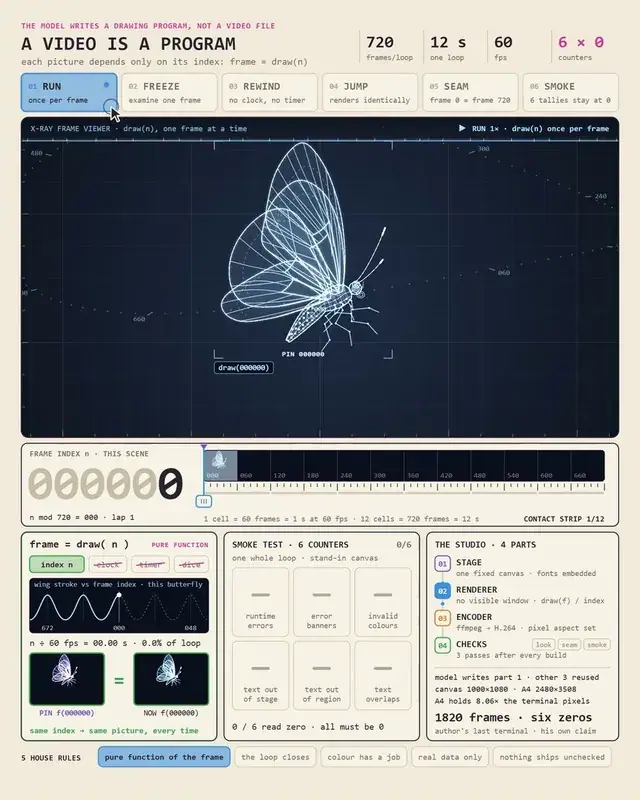
720 frames. 12 seconds. 6 counters. All at 0.

Opus 5.5 can't hand over a video file, one builder says. He made that gap the method.

> STAGE - one fixed 1000x1080 canvas, fonts baked in
> RENDER - a windowless engine calls draw(f) once per frame number
> ENCODE - ffmpeg writes H.264, pixel aspect ratio declared
> CHECK - three passes after every build

By his account the model writes only the first, a drawing program. The other three get reused.

Each picture depends on its number alone: no clock, no timer, no dice that land differently each run.

So any frame renders the same every time. A fix is a small edit and a re-render.

The sample loop is 720 pictures in 12 seconds. A hand animator at 12 drawings a second would need 144.

The smoke test plays one loop unseen and counts six kinds of defect, from script errors to text on text.
Six yes/no gates before a human looks.

The seam check puts frame 0 against frame 720. One changed pixel means some motion isn't periodic.

He reports a last render of 1,820 frames with six zeros. At the sample's 60 fps that would be about half a minute.

Let one frame read a clock and the same number stops giving the same picture.

We drew the rule as an X-ray butterfly, its wingbeat computed from the frame number ↓
Listed in yihui-dev/awesome-opus5-5-videos. The film and prompt belong to @0xKarmi. Request a change